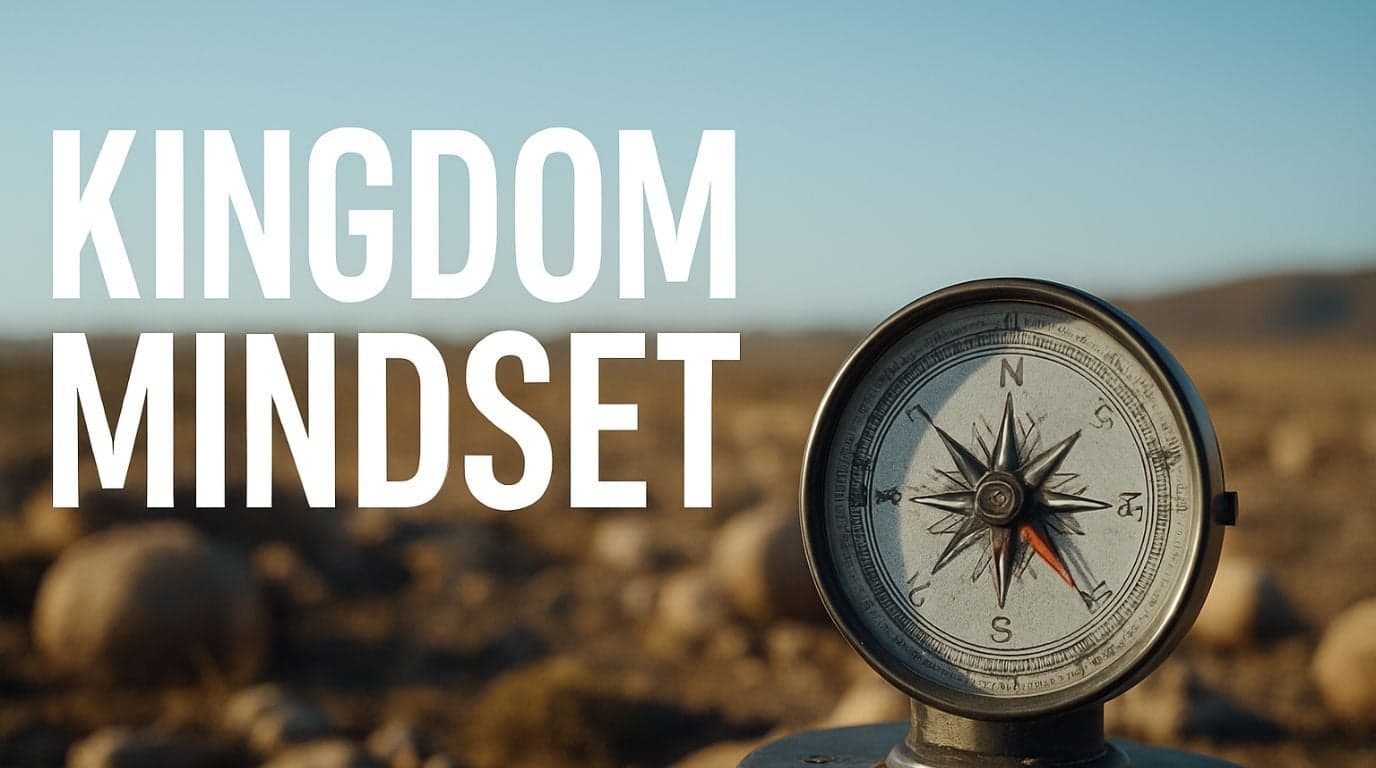
Most Christians don't have a Kingdom mindset. They have a consumer mindset wrapped in Christian language.
They ask, "What can God do for me?" instead of "What has God called me to do?"
They evaluate church based on what they get out of it, not what they can contribute. They measure spiritual growth by how they feel, not by how they obey. They make decisions based on comfort, convenience, and personal preference, and then pray that God blesses it.
That's not a Kingdom mindset. That's a self-centered faith system that treats God like a life coach instead of a King.
A Kingdom mindset is fundamentally different. It doesn't start with you. It starts with God. It doesn't ask what serves your plans. It asks what advances His Kingdom.
And when you develop a Kingdom mindset, everything changes. Your priorities shift. Your decisions realign. Your faith stops being about you and starts being about the King and His mission.
What a Kingdom Mindset Actually Is
A Kingdom mindset is viewing everything in your life through the lens of God's rule and reign.
It's waking up every day and asking: How does my life today build the Kingdom? How do my words, my work, my relationships, my money, my time advance what God is doing in the world?
It's the shift from "What do I want?" to "What does the King want?"
From "What makes me happy?" to "What brings Him glory?"
From "How do I get ahead?" to "How do I serve His purposes?"
This isn't about denying that you have needs, desires, or dreams. It's about submitting all of those things to a higher authority. It's about recognizing that your life isn't your own, you were bought with a price (1 Corinthians 6:19-20). And that changes everything.
A Kingdom mindset doesn't treat Jesus as an addition to your existing life. It makes Him the foundation that everything else is built on.
Matthew 6:33 is the defining verse: "Seek first his kingdom and his righteousness, and all these things will be given to you as well."
Seek first. Not seek also. Not seek when it's convenient. First.
The Kingdom comes before your career. Before your comfort. Before your reputation. Before your plans.
And when you seek it first, God handles the rest.
Why Most Christians Don't Have It
Most believers have never been discipled into a Kingdom mindset. They've been trained in consumer Christianity instead.
They were told, "Come to Jesus and your life will get better." They were promised peace, purpose, and blessing. And all of that is true, but it's not the whole truth.
The Gospel isn't just about what you gain. It's about whose authority you're now under. You're not just forgiven. You're transferred into a new Kingdom (Colossians 1:13). And in that Kingdom, Jesus is King. Not advisor. Not helper. King.
But most churches don't disciple people into that reality. They disciple them into attendance, service, and emotional experiences. They train believers to consume sermons, participate in programs, and show up on Sundays. But they don't teach them to think like Kingdom citizens.
So believers stay stuck in a self-focused mindset. They pray for God to bless their plans instead of asking what His plans are. They make decisions based on what's best for them and then expect God to rubber-stamp it. They treat obedience as optional and wonder why their faith feels hollow.
A Kingdom mindset can't coexist with a me-centered life. You have to choose.
The Shift From Self-Focus to Kingdom Focus
Developing a Kingdom mindset requires a fundamental shift in how you see yourself and your purpose.
Self-focus asks: What do I want? Kingdom focus asks: What does God want?
Self-focus says: God exists to make my life work. Kingdom focus says: I exist to advance His Kingdom.
Self-focus evaluates decisions by: Will this make me happy? Kingdom focus evaluates decisions by: Will this bring Him glory?
Self-focus prays: God, bless what I'm doing. Kingdom focus prays: God, align me with what You're doing.
This isn't a minor adjustment. It's a complete reorientation. It's the difference between living for yourself and living for the King.
And it's the difference between a faith that stagnates and a faith that transforms.
What the Bible Says About Kingdom Mindset
Scripture doesn't use the phrase "Kingdom mindset," but it describes it constantly.
Paul writes, "Set your minds on things above, not on earthly things" (Colossians 3:2). That's Kingdom thinking. Your thoughts, priorities, and focus are anchored in eternal reality, not temporary circumstances.
Romans 12:2 commands, "Do not conform to the pattern of this world, but be transformed by the renewing of your mind." The world trains you to think about yourself first. Kingdom mindset retrains you to think about God's purposes first.
Philippians 2:5 says, "In your relationships with one another, have the same mindset as Christ Jesus." And what was Christ's mindset? Verse 7 answers: "He made himself nothing by taking the very nature of a servant."
Jesus didn't come demanding to be served. He came to serve. He didn't live for Himself. He lived for the Father's will. That's the Kingdom mindset modeled perfectly.
And if you're in Christ, that's the mindset you're called to develop.
A Kingdom Mindset Reorders Your Priorities
When you develop a Kingdom mindset, your priorities don't just shift, they get completely reordered.
Time: You stop asking, "What do I want to do today?" and start asking, "How has God called me to steward today?" Your schedule becomes a tool for Kingdom work, not just personal preference.
Money: You stop treating your income as yours to do with as you please. You start seeing it as God's resources entrusted to you for Kingdom purposes. Generosity becomes normal, not exceptional.
Relationships: You stop evaluating people based on what they can do for you. You start asking, "How can I serve them? How can I point them to Jesus? How can I help them grow?"
Work: Your job isn't just a paycheck. It's a mission field. Your workplace is where you represent the Kingdom. Your work ethic, integrity, and character become a witness.
Decisions: You stop making choices based solely on what benefits you. You start filtering every decision through the question: Does this build God's Kingdom or mine?
This isn't legalism. It's alignment. It's bringing every area of your life under the authority of the King.
A Kingdom Mindset Changes How You Handle Suffering
One of the clearest tests of whether you have a Kingdom mindset is how you respond when life doesn't go your way.
A self-focused believer sees hardship as a problem to escape. A Kingdom-focused believer sees it as an opportunity for growth and witness.
James 1:2-4 says, "Consider it pure joy, my brothers and sisters, whenever you face trials of many kinds, because you know that the testing of your faith produces perseverance. Let perseverance finish its work so that you may be mature and complete, not lacking anything."
That's Kingdom thinking. Trials aren't interruptions to your faith. They're part of how God forms you into maturity.
Romans 8:28 promises, "In all things God works for the good of those who love him, who have been called according to his purpose." The "good" isn't your comfort. It's being conformed to the image of Christ (Romans 8:29). That's the Kingdom goal.
A Kingdom mindset doesn't demand that God fix your circumstances. It trusts that God is using your circumstances to build His Kingdom in and through you.
That doesn't mean you don't pray for breakthrough. It means you don't lose faith when the breakthrough looks different than you expected.
A Kingdom Mindset Confronts Consumer Christianity
Consumer Christianity has convinced believers that church exists to meet their needs. That worship should make them feel a certain way. That sermons should be entertaining. That ministry should revolve around their preferences.
A Kingdom mindset flips that completely.
Church isn't a service you consume. It's a body you contribute to. Worship isn't about what you get out of it. It's about what you give to God. Sermons aren't entertainment. They're equipping for obedience. Ministry isn't about your comfort. It's about advancing the Gospel.
Hebrews 10:24-25 says, "Let us consider how we may spur one another on toward love and good deeds, not giving up meeting together, as some are in the habit of doing, but encouraging one another."
The goal isn't to show up and be served. It's to show up and serve. To encourage. To equip. To build up.
When believers approach church with a Kingdom mindset, the church stops being a place people attend and becomes a force that transforms culture.
A Kingdom Mindset Requires Daily Surrender
You don't develop a Kingdom mindset once and then coast. You have to choose it every single day.
Because every day, your flesh wants to default back to self-focus. Every day, the culture pressures you to build your own kingdom. Every day, you're tempted to make decisions based on comfort instead of calling.
That's why Jesus said, "Whoever wants to be my disciple must deny themselves and take up their cross daily and follow me" (Luke 9:23).
Daily. Not once. Not when it's convenient. Daily.
A Kingdom mindset is built through daily surrender. Daily obedience. Daily alignment with God's Word. Daily choosing His will over yours.
It's waking up and praying, "God, this day is Yours. My time is Yours. My decisions are Yours. Use me for Your Kingdom."
And then actually living like you mean it.
What a Kingdom Mindset Looks Like in Real Life
Kingdom mindset isn't abstract theology. It shows up in how you actually live.
It's the employee who turns down the promotion because it would compromise their integrity or pull them away from their family and ministry commitments.
It's the parent who prioritizes discipling their kids over climbing the career ladder.
It's the person who gives sacrificially even when their budget is tight because they trust God's provision more than their bank account.
It's the believer who forgives quickly, serves humbly, and speaks truth even when it costs them socially.
It's the Christian who doesn't need credit for their work because they're building for an audience of One.
It's the couple who opens their home for ministry even when it's inconvenient.
It's the worker who does their job with excellence not to impress a boss, but to represent the King.
A Kingdom mindset doesn't make you more spiritual. It makes you more obedient. And obedience is what builds the Kingdom.
The Cost of a Self-Centered Mindset
When you live with a me-first mindset, you miss what God is doing.
You pray for breakthrough but you're holding onto the very thing God is asking you to surrender. You ask for purpose but you refuse to obey the calling He's already given. You want intimacy with God but you won't align your life with His will.
And you end up spiritually stuck. Frustrated. Wondering why your faith feels powerless.
It's not because God isn't moving. It's because you're still trying to build your kingdom instead of His.
Proverbs 14:12 warns, "There is a way that appears to be right, but in the end it leads to death."
You can do what seems right to you. You can build a life that makes sense by the world's standards. You can chase comfort, success, and approval.
But if it's not aligned with the Kingdom, it's headed toward emptiness.
The Invitation to Kingdom Thinking
Developing a Kingdom mindset isn't complicated. But it is costly.
It costs you control. It costs you comfort. It costs you the right to live for yourself.
But what you gain is infinitely greater.
You gain purpose that lasts beyond your lifetime. You gain a life that actually matters. You gain intimacy with the King. You gain the privilege of participating in what God is doing in the world.
Romans 12:1 frames it perfectly: "Offer your bodies as a living sacrifice, holy and pleasing to God, this is your true and proper worship."
Your life is the offering. Not just your Sundays. Not just your prayers. Your whole life.
And when you offer it fully to the King, you discover what you were actually created for.
The Call
So here's the question: Are you living with a Kingdom mindset or a me-centered mindset?
Are your decisions filtered through "What does God want?" or "What do I want?"
Are you building His Kingdom or yours?
You don't have to answer out loud. But you do have to answer honestly.
Because a Kingdom mindset isn't just a nice idea. It's the difference between a faith that transforms and a faith that stagnates.
And the King is calling you to more.
Internal Links:
- Understand what the Kingdom of God actually is
- Learn the difference between active and passive faith
- Discover why passive Christianity keeps you stuck
Next Step: Join BKB Academy, where we learn to think and live like Kingdom citizens.